
Public Sector Operating Model Transformation: Why Data Ownership Comes First
When a board mandate for change lands, a public sector operating model has to change before any new system will help. Here is why data ownership is the place to start, and how to redesign processes and roles so the change outlasts the contractors.
The board has set a target to redesign how services run, and the operations director must deliver it without disrupting front-line services. A public sector operating model is the way a body arranges its processes, people, governance and data to deliver services. This post explains why redesigning it starts with data ownership, and how to do it.
Key takeaways
- A new system inherits the operating model it is dropped into, so unowned data makes the new platform as unreliable as the old one.
- Digital and data staff are around 5% of the Civil Service, against benchmarks of 8 to 12% in regulated private sector industries, according to DSIT.
- Contractors fill the gap, but DSIT warns that temporary staff hinder the retention of institutional knowledge.
- Name a single accountable owner for each key dataset, and escalate disputes to a senior sponsor.
- Start by listing your 10 most-used datasets and the person accountable for each.
Why does operating model change stall in the public sector?
Operating model change stalls in the public sector because most bodies grew around functions, programmes and old systems, not around the whole service a citizen receives. Nobody designed the handoffs between teams; they built up over years, one workaround at a time.
The trigger is usually a deadline set from above, while the internal team is full with day-to-day work. So the work goes to contractors.
The State of Digital Government Review, published by the Department for Science, Innovation and Technology (DSIT) in January 2025, shows the result. Digital and data employees are around 5% of the Civil Service, against benchmarks of 6% for other governments and 8 to 12% in regulated private sector industries.
The gap is filled from outside, and that rarely leaves skills behind. Contractors account for approximately 18% of public sector headcount, and the review warns that “use of temporary staff also hinders retention of institutional knowledge.”
Leadership capability matters too. In 2023 the National Audit Office (NAO) said: “Many business leaders do not yet have the expertise required to comprehend and tackle the challenges the civil service faces in a digital age.”
Why is data ownership the sharpest problem?
Data ownership is sharpest because teams carry the risk for their own data and nobody owns the shared view. The DSIT review notes that “a strong sense of data ownership and reluctance to aggregate personal data further inhibit sharing.” That is a rational response to accountability, not obstruction.
What does a stalled operating model risk for a public body?
A stalled operating model puts every later investment at risk, because each new system or restructure inherits the same unclear handoffs. Staff rekey data between teams, board reports disagree, and the next programme starts from the same position as the last.
The risk compounds in three ways:
- Dependence: each year of contractor-led change without skills transfer leaves the next programme more reliant on outside help.
- Accountability: UK GDPR requires organisations to take responsibility for personal data and show how they comply, and the Information Commissioner’s Office (ICO) Accountability Framework asks for named responsibility.
- Assurance: the GDS Service Standard asks teams to solve a whole problem for users and to have a multidisciplinary team, which assessors check.
The internal politics add friction. Finance wants results this year, service leads protect headcount, and the board judges IT on a go-live date. An operating model redesign has to make those trade-offs visible rather than pretend they do not exist.
How do you redesign a public sector operating model?
Redesign a public sector operating model in 6 phases, from inside your teams to a handover your own staff can run. Start with discovery, as the GDS Service Manual describes, then change in small, tested steps. The diagram shows the order, with the fork where data ownership is agreed or escalated.
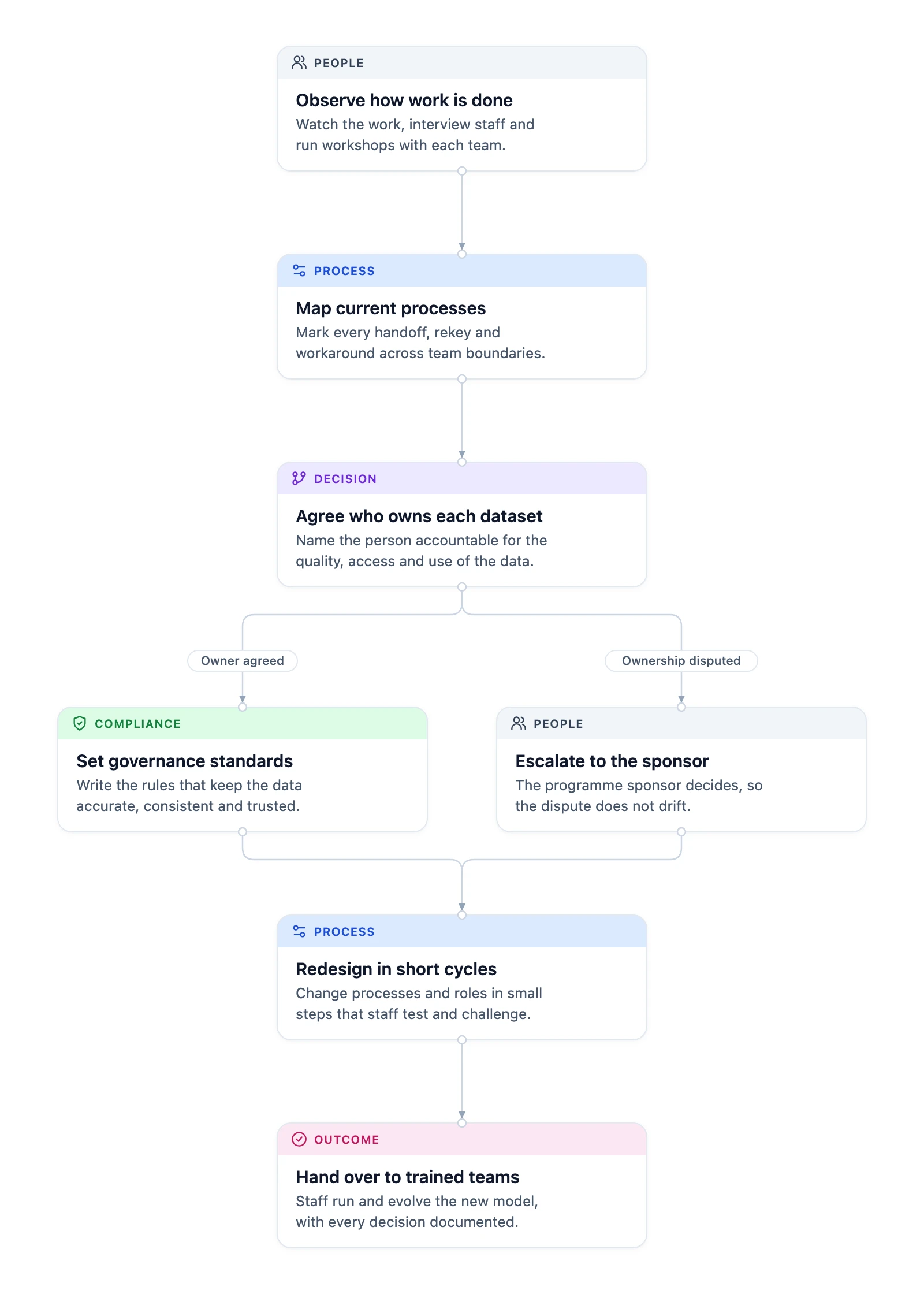
- Observe how work is really done. Sit with teams, watch the work, run interviews and hold workshops. The evidence must be something staff recognise as their own week.
- Map current processes end to end. Map each process across team lines, marking handoffs, rekeying and workarounds, so there is one shared picture of where time is lost.
- Agree who owns each dataset. A data owner is the named person accountable for the quality, access and use of one dataset. List the owners, with disputes in plain sight.
- Set governance standards, or escalate. Where ownership is agreed, write the standards that keep data accurate and consistent. Where it is disputed, the programme sponsor decides, so the question does not drift.
- Redesign in short cycles. Change processes and roles in small steps that staff test and challenge, so progress is visible early.
- Train and document throughout. Run training during the work, not just at the end, and write down every decision, so teams can run the model without outside help.
A new system inherits the operating model it is dropped into, so if nobody owns the data, the new platform will be as unreliable as the old one.
Which government standards shape the redesign?
Four government standards give the redesign a common reference, which helps when assessors or auditors ask how decisions were made.
| Standard | What it asks for | How the redesign meets it |
|---|---|---|
| GDS Service Standard | Points 2, 6 and 10: “Solve a whole problem for users”, “Have a multidisciplinary team”, “Define what success looks like” | End-to-end maps, mixed teams and agreed measures |
| Government Data Quality Framework | Assess, communicate and improve data quality | Quality rules set per dataset |
| Data Maturity Assessment for Government | Measure and improve your data ecosystem | A baseline to score before and after |
| GovS 005 Digital | Expectations for managing digital, data and technology | Clear roles across business and IT |
Should a public body redesign its operating model or buy a system?
Redesign the operating model first when the problem sits between teams; buy a system first when one team owns a clearly failing tool.
| If this describes you | Start with | Why |
|---|---|---|
| Teams dispute who owns key data | Operating model redesign | No system can settle an ownership dispute |
| Staff rekey data between teams | Process redesign, then integration | Fixing the handoff shrinks what you build |
| One system is out of support, but the process works | System replacement | The model is sound; the tool is not |
| A board deadline and no spare capacity | Both, with skills transfer in the contract | Avoids repeat contractor dependency |
If your priority is the platform and data delivery, see Thornacre’s digital transformation service. For reporting and data platforms, see data analytics and AI.
When is operating model redesign not the right choice?
Operating model redesign is the wrong choice when the problem is one failing system with clear owners, or when no senior sponsor will make decisions. In the first case, a migration is the simpler route. In the second, you get maps that nobody acts on.
The approach also asks for staff time for interviews, workshops and testing, so plan it alongside day-to-day work rather than on top of it.
The common objection is: “We will lose control and knowledge to a supplier.” There are three answers. Staff work in every phase, not just at handover. Training runs during delivery, not at the end. Every decision is written down, so staff can explain and change it without outside help.
What should an operations director do first?
List the 10 datasets your services use most, and write beside each the name of the person accountable for it. Each blank or dispute marks a place where your change will stall.
Then take that list to the senior sponsor and agree who settles disputes. That one decision turns a list of gaps into a plan.
Frequently Asked Questions
How much of the organisation should be in scope?
Scope should start with the services where handoffs and data disputes block a known priority, such as a service redesign the board has asked for. Discovery on 1 service tests the approach and builds evidence. Wider change follows only where that evidence shows the same problems repeat across teams.
Does operating model redesign work with the systems we already run?
Operating model redesign works with existing systems, because it changes how work and data ownership are organised around them. Process maps show where systems force rekeying or workarounds. Some fixes need no new technology; others become clear, scoped requirements for integration or replacement.
Will the change disrupt front-line services?
The risk of disruption stays low because processes change in small, tested steps, not in one cutover. Staff try each change before it becomes standard, and the old way stays in place until the new one works. Front-line teams help design each change.
Who should be the data owner for a shared dataset?
The data owner should be the senior person whose service depends most on the dataset’s quality, not the team that hosts the system. One owner per dataset keeps accountability clear under the ICO Accountability Framework. Other teams become data users with agreed access rules.
Will we depend on a supplier after the programme ends?
Dependence is avoidable if the supplier plans its exit from the start. Thornacre runs training throughout, records every decision in plain English and involves your staff in each phase. By handover, your teams can run and evolve the new ways of working without outside help.
How do we start a public sector operating model redesign?
Start by naming a senior sponsor who can settle ownership disputes, then pick 1 service with a known problem. The first phase is discovery: observation, interviews and process mapping in that service. That gives you evidence for the business case before you commit to wider change.
If a board mandate is forcing change and you are not sure where the handoffs break, ask us for an operating model assessment workshop. Email hello@thornacre.com and we will agree a short discovery on 1 service to start. See our operating model transformation service for the full approach.
This post is general guidance only; consult your legal or compliance teams for advice on your specific requirements.