
Public Sector Digital Transformation: How to Retire Paper Forms Without Excluding Anyone
Most public sector digital transformation stops at an online form while staff still rekey every submission. Here is how to redesign a paper process end to end, add an assisted digital route and switch the paper off for good.
The post room opens another tray of application forms, and staff key each one into the case system by hand. Public sector digital transformation should end that, but most programmes stop at an online form. This post shows operations directors how to redesign the whole process, add an assisted route and retire the paper for good.
Key takeaways
- Nearly half of public services still lack a digital pathway: 47% in central government and 45% in the NHS, according to DSIT.
- An online form on top of a paper process is a “digital veneer”; staff still rekey the data behind it.
- A process is only digital when the paper route can be switched off.
- The paper route can only be switched off once an assisted digital route runs through the same service as everyone else.
- Start by following 10 recent submissions of one paper form from envelope to record.
Why does public sector digital transformation stall at the online form?
Public sector digital transformation stalls because the process behind the form still assumes paper. The Department for Science, Innovation and Technology (DSIT) calls this a “digital veneer”: a modern front end on top of manual work.
The State of Digital Government Review, published by DSIT in January 2025, gives the example of Pension Credit. You can apply online, but case workers still re-enter the information into several separate legacy systems.
The same review found:
- 47% of central government services and 45% of NHS services still lack a digital pathway.
- The Driver and Vehicle Licensing Agency (DVLA) processes around 45,000 letters every day.
- Defra still manages over 500 services accessed through paper forms.
- Defra estimates that 60% of its contact centre calls are caused by broken or unclear digital pathways.
None of this is the service team’s fault. Paper processes grew one exception at a time, and an e-form tool copies every box. Frontline staff trust the paper, legal teams assume wet-ink signatures, and leaders expect results on day one. Meanwhile, the people who understood why each box exists move on.
What does a half-digital process put at risk for a public body?
A half-digital process doubles the work and the risk: staff run two routes, rekey data and chase incomplete submissions. Errors enter at every rekey, and post, scanning and storage still consume staff time.
The exposure is also legal. The public sector equality duty in the Equality Act 2010, section 149 requires public bodies to have due regard to equality. A switch to online-only without research into who cannot go online puts that duty at risk.
The numbers on exclusion are real. The Office for National Statistics (ONS) found 6.3% of UK adults had never used the internet in 2020, and only 54% of adults aged 75 and over were recent users.
Waiting makes it worse. Each new paper variant, local workaround and spreadsheet adds to what discovery must unpick later.
How do you move a public sector paper process online?
Move a paper process online in 7 steps, from watching how the work is done today to retiring the paper. The key decision is whether every user can self-serve, which the diagram shows as a fork. The phases follow the discovery, alpha, beta and live approach in the GDS Service Manual.
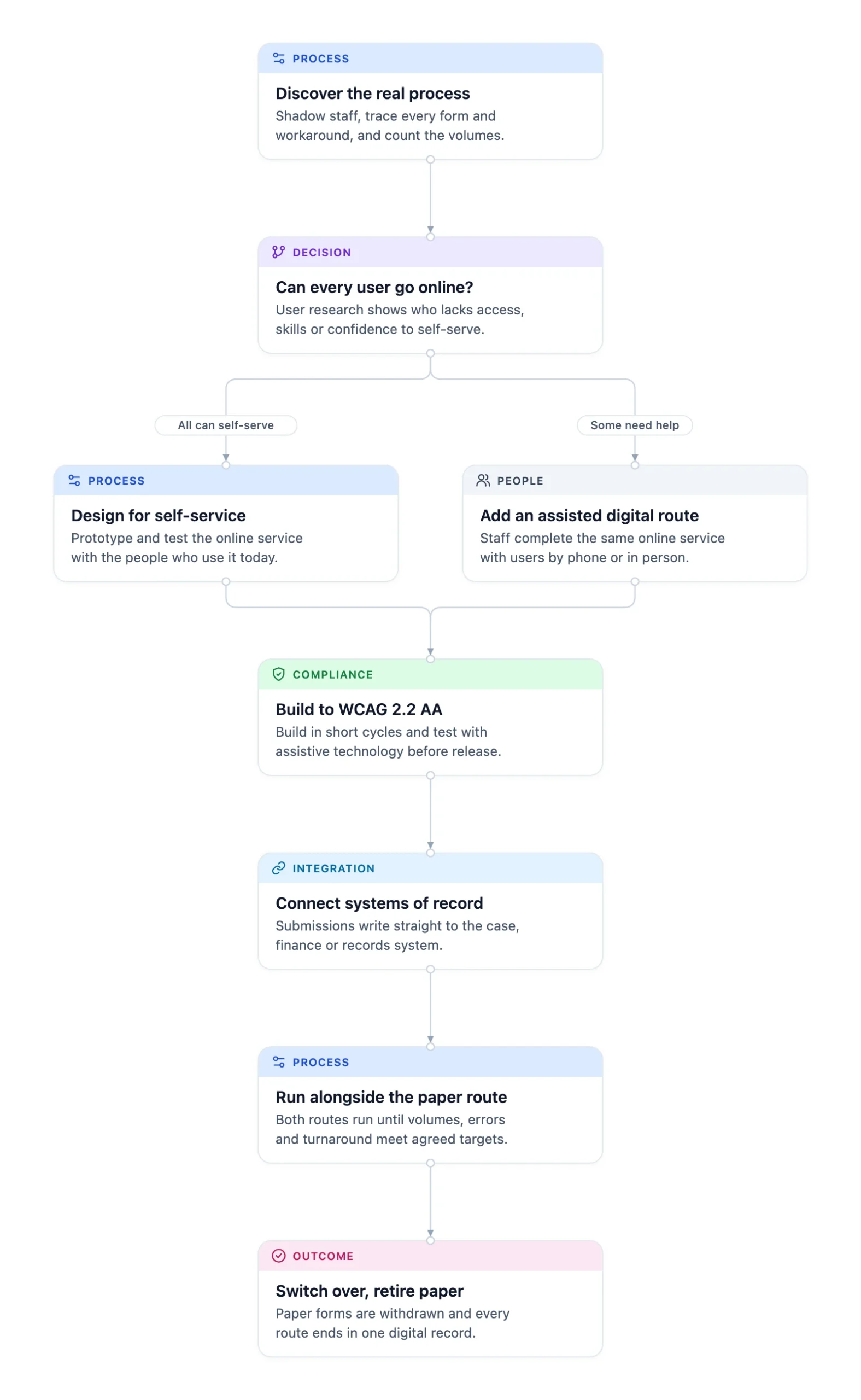
- Discover the real process. Shadow staff, collect every form version, map workarounds, count volumes and check which steps the law sets.
- Decide who can self-serve. Research with users, including people with access needs, shows who lacks access, skills or confidence. If anyone does, add an assisted digital route.
- Design the service with its users. Prototype and test with today’s paper users, and drop questions that only existed for paper.
- Build it accessibly. Build in short cycles and test against WCAG 2.2 AA with assistive technology before each release.
- Connect the systems of record. Submissions write to the case, finance or records system through APIs, so nobody rekeys.
- Run alongside the paper route. Both routes run until volumes, errors and turnaround meet targets agreed before launch.
- Switch over and retire the paper. Withdraw the forms, update letters and phone scripts, and train staff, so every route ends in one digital record.
Assisted digital support is help for people who cannot use an online service alone, given by phone, in person or by webchat, as the GDS Service Manual sets out.
A process is only digital when the paper route can be switched off, and it can only be switched off once the assisted route runs through the same digital service as everyone else.
Who must be able to use a public sector service?
The GDS Service Standard, point 5, states the duty plainly: “Provide a service that everyone can use, including disabled people and people with other legally protected characteristics. And people who do not have access to the internet or lack the skills or confidence to use it.”
The Public Sector Bodies Accessibility Regulations 2018 add a legal requirement for accessible websites and apps, with a published accessibility statement. Thornacre’s accessibility services cover the testing.
How do you choose between self-service and assisted digital?
Choose self-service only when research shows every user can go online; otherwise add an assisted route. Keeping paper as a fallback is rarely the right answer, because it keeps two processes and two records alive.
| Criterion | Self-service only | Self-service plus assisted | Paper kept as fallback |
|---|---|---|---|
| Suits | Staff, professionals, businesses | The public and vulnerable residents | Rarely the best choice |
| Records | One digital record | One digital record | Two processes, two records |
| Equality risk | High if research is thin | Low | Low |
| Ongoing effort | Lowest | Low, plus staff time | Highest: post, scanning, rekeying |
| Paper retires? | Yes | Yes | No |
Use these rules:
- If users act for an organisation, such as suppliers or GPs, plan self-service only.
- If the public use the service, add an assisted route sized from research.
- If a law names a paper form or wet-ink signature, keep that step and digitise the rest.
Do you still need wet-ink signatures?
Often not. Under section 7 of the Electronic Communications Act 2000, an electronic signature is admissible as evidence. Some statutory forms and deeds set their own rules, so check each signature with your legal team during discovery.
When is digitising a paper form not the right choice?
Digitising a form is the wrong choice when the form should not exist at all. If it asks for data you already hold, remove it; Service Standard point 2 asks teams to solve a whole problem for users.
- If ownership or roles are the real issue, start with operating model transformation.
- If the process is digital but data must move between systems, you need a data migration.
- If a form is used a few times a year, a clear accessible document may be simpler.
The common objection is: “Some of our residents cannot go online, so we must keep paper.” Those residents need help, not paper. When staff complete the online service with them, everyone shares one record.
The internal politics are real. Frontline teams fear losing the paper they trust, and finance wants results before the parallel run ends. The honest trade-off is that parallel running means staffing two processes for a while, so agree the switchover targets with both groups before launch.
What should an operations director do first?
Follow 10 recent submissions of one paper form from envelope to record, and count how often the same data is written, keyed or checked. That count is your business case for public sector digital transformation, and it needs no supplier to produce.
Pick a high-volume form with one clear owner and few legal constraints. Volume makes the rekeying effort visible, and one owner keeps decisions quick.
Frequently Asked Questions
Which paper process should a public body digitise first?
Pick a high-volume process with one clear owner and few legal constraints on its forms. Volume makes the rekeying effort visible, and one owner keeps decisions quick. Scope is agreed per phase, so you can stop or change course after discovery or after the first service goes live.
Will the new service work with our existing case and finance systems?
A new service works with existing systems if they accept data through an API or a supported import. Discovery lists every system the paper process feeds today. Where a system has no usable interface, an integration layer writes submissions to the system of record without rekeying.
What if residents keep sending paper after launch?
Residents keep sending paper while old forms are easy to find. During parallel running, staff key any paper that arrives into the new service, so there is still one record. At switchover, withdraw old forms and point letters and phone scripts to the online or assisted route.
Does the public sector equality duty stop us going digital?
The public sector equality duty does not stop digital services; it requires due regard to equality when you design them. Research with excluded groups, an assisted route and accessibility testing give the evidence that you had that regard. Record each decision in your equality impact assessment as you go.
Can we use AI to read our paper forms instead?
AI can extract data from scanned forms, but the post, scanning and checking stay. Redesign the process first, so the data arrives in the right fields. AI transformation then adds most value on the digital process. Reading forms with AI suits old archives that nobody will send again.
How do we start a public sector digital transformation?
Start with a discovery on 1 high-volume paper process. Shadow staff, map the process and research who needs assisted support. The output is a service design, a channel plan and a scoped plan for build and switchover before you commit to further phases.
If a paper process takes your team hours every week, ask us for a process discovery workshop. Email hello@thornacre.com and Thornacre will map one paper process with you and show what retiring it would take. See our digital transformation service for the full approach.
This post is general guidance only; consult your legal or compliance teams for advice on your specific requirements.