
Digital Transformation That Moves Manual Processes and Services Online
Digital transformation for regulated organisations still running on paper forms, emailed attachments, spreadsheets and manual sign-offs: accessible online services that write straight to your systems of record, run alongside the old process until you switch over.
A change of address arrives by email, is copied into a spreadsheet and waits in an inbox for approval before anyone keys it in. Thornacre’s digital transformation service moves manual processes like this online, for customers and staff, as accessible services that feed your systems. It is for regulated organisations where work still moves by hand.
| Area | Detail |
|---|---|
| Who it is for | CTOs and IT Directors, Heads of Data, CISOs, Compliance Leads and DPOs, and COOs in any regulated organisation |
| The problem it solves | Paper forms, spreadsheets, email approvals and phone-and-post journeys, rekeyed by hand, chased when incomplete and impossible to audit |
| What we deliver | Process discovery, online services, staff workflows, automated hand-offs, assisted digital routes, switchover |
| How we work | Discovery, alpha, beta and live phases in short agile cycles, as the GDS Service Manual describes |
| Regulations and standards | UK GDPR, WCAG 2.2, Equality Act 2010, Electronic Communications Act 2000, plus sector rules (see below) |
What problem does digital transformation solve for manual processes?
Digital transformation removes the effort, delay and errors of work that moves between people by hand. Data is typed from one place into another, approvals wait in inboxes, and nobody can see where a case is.
Digital transformation, as Thornacre uses the term, is the redesign of a manual process as a digital service. It ends when the old route is switched off. Typical examples:
- Paper application, claim and onboarding forms become online services.
- Spreadsheet trackers, shared inboxes and email approvals become case tools with tracked sign-offs.
- Data rekeyed between two systems moves between them automatically.
- Phone-and-post customer journeys become self-service, with an assisted route.
Each senior role carries part of the problem:
- CTO or IT Director: forms and spreadsheets bolted around the line-of-business system, with every record still rekeyed into it.
- Head of Data: errors entered at each rekey, and spreadsheet copies nobody can reconcile.
- CISO: personal data in email attachments, scans and shared spreadsheets, outside any access control.
- Compliance Lead or DPO: no audit trail showing who approved what, and when.
- COO: staff hours lost to post, chasing, copying and checking.
Why do online forms not fix a manual process?
Online forms fail when the process behind them still assumes manual hand-offs, so staff still rekey or forward each submission. This is not the operations team’s fault: manual processes grew one exception at a time. Frontline staff trust the workaround they know, legal teams assume wet-ink signatures and the board expects results on day one.
How does Thornacre move a manual process online?
Thornacre delivers digital transformation in 7 steps, from watching how the work is done today to switching off the old route. The key decision is whether every user can self-serve, shown as the fork in the diagram.
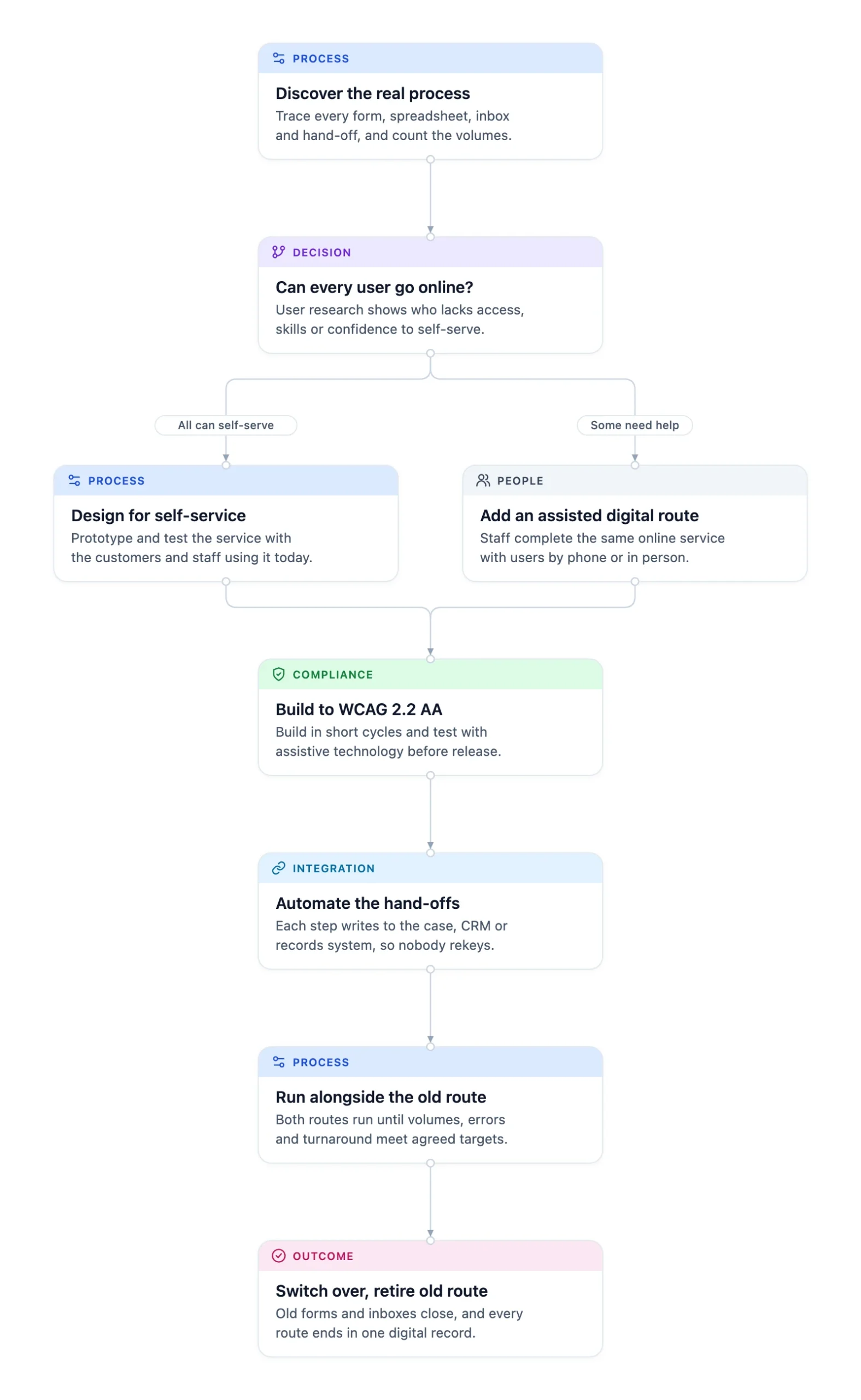
- Discover the real process. We shadow staff, trace every form, spreadsheet and inbox the work passes through, map hand-offs, count volumes and check which steps the law sets. You keep the process map.
- Decide who can self-serve. Research with users, including people with access needs, shows who lacks access, skills or confidence. If anyone does, we add an assisted digital route.
- Design the service with its users. We prototype and test with today’s customers and staff, and drop steps that only existed for paper, email or rekeying.
- Build it accessibly. We build in short cycles and test against WCAG 2.2 AA with assistive technology before each release, backed by our accessibility services.
- Automate the hand-offs. Submissions and approvals write to your case, CRM, finance or records system through APIs, and each finished step starts the next, so nobody rekeys. Where that system needs extending, see CRM and ERP integration.
- Run alongside the old route. Both routes run until volumes, errors and turnaround meet targets agreed before launch.
- Switch over and retire the old route. We withdraw forms, close shared inboxes, update letters and phone scripts, and train staff, so every route ends in one digital record.
Assisted digital support is help for people who cannot use an online service alone, given by phone, in person or by webchat, as the GDS Service Manual sets out. A process is only digital when the old route can be switched off, and it can only be switched off once the assisted route runs through the same digital service as everyone else.
You can start this week without a supplier. Follow 10 recent cases of one process from first contact to final record, and count how often the same data is written, keyed, copied or checked. That count is your business case for digital transformation.
What do you get from a digital transformation project?
Digital transformation leaves you a working service, a retired manual route and a team that can run both.
| Deliverable | What it means for you |
|---|---|
| Online and assisted service | One accessible service, used by customers and by staff helping them |
| Staff workflows and approvals | Case, task and sign-off steps tracked with a full history |
| Automated hand-offs | Data moves between your systems without rekeying or forwarding |
| Audit trail | Who submitted, changed and approved each record, and when |
| Switchover evidence and training | Parallel-run data, trained staff and documents you own |
Which regulations apply when you move a manual process online?
Three kinds of law apply to every new digital service in the UK: data protection, equality and electronic signatures. Each sector then adds its own rule.
- Data protection: UK GDPR and the Data Protection Act 2018 require lawful, secure handling of personal data. We collect only the data the service needs, with protection designed in from discovery, as the Information Commissioner’s Office (ICO) guides.
- Equality: the Equality Act 2010, section 29 prohibits discrimination in providing services, so an online-only route needs research into who cannot use it.
- Electronic signatures: under section 7 of the Electronic Communications Act 2000, an electronic signature is admissible as evidence. Some statutory forms, deeds and regulated records set their own rules, so we check each signature with your legal and compliance teams.
| Sector | Regulation or framework | What it requires | How the service addresses it |
|---|---|---|---|
| Insurance | FCA Consumer Duty, PRIN 2A.6 | No unreasonable barriers when customers claim or make changes | Self-service plus assisted routes for claims and changes |
| Life sciences and pharma | FDA 21 CFR Part 11 and EU GMP Annex 11 | Trustworthy electronic records and signatures in place of paper | Signature controls and audit trails on each record change |
| Private healthcare | NHS Accessible Information Standard | Providers of NHS-funded care meet disabled people’s information needs | Accessible formats and assisted routes recorded in the service |
| Banking and payments | European Accessibility Act | Accessible consumer banking services for EU customers | Onboarding and servicing journeys built to WCAG 2.2 AA |
The GDS Service Standard, point 5, states the design principle plainly: “Provide a service that everyone can use, including disabled people and people with other legally protected characteristics. And people who do not have access to the internet or lack the skills or confidence to use it.”
How do you choose between self-service and assisted digital?
Choose self-service only when research shows every user can go online; otherwise add an assisted route. The Office for National Statistics (ONS) found 6.3% of UK adults had never used the internet in 2020, and only 54% of adults aged 75 and over were recent users.
| Criterion | Self-service only | Self-service plus assisted | Old route kept as fallback |
|---|---|---|---|
| Suits | Staff, professionals, businesses | Consumers and vulnerable customers | Rarely the best choice |
| Records | One digital record | One digital record | Two processes, two records |
| Equality risk | High if research is thin | Low | Low |
| Ongoing effort | Lowest | Low, plus staff time | Highest: post, inboxes, rekeying |
| Old route retires? | Yes | Yes | No |
- If users are your own staff or act for an organisation, such as brokers, suppliers or referrers, plan self-service only.
- If consumers use the service, add an assisted route sized from research.
- If a law names a paper form or wet-ink signature, keep that step and digitise the rest.
When is digital transformation not the right choice?
Digital transformation is the wrong choice when the step should not exist at all. If a form or approval asks for data you already hold, remove it; Service Standard point 2 asks teams to solve a whole problem.
- If ownership or roles are the real issue, start with operating model transformation.
- If the work is already digital but records must move to a new system, you need a data migration.
- If a process runs a few times a year, a clear document or checklist may be simpler.
The common objection is: “Some of our customers cannot go online, so we must keep paper.” Those customers need help, not paper. When staff complete the online service with them, everyone shares one record. The honest trade-off: parallel running means staffing two processes for a while.
Waiting adds effort: every new spreadsheet, shared inbox and local workaround adds to what discovery must unpick later.
Frequently Asked Questions
Which manual process should we move online first?
Pick a high-volume process with one clear owner and few legal constraints on its steps. Volume makes the rekeying effort visible, and one owner keeps decisions quick. Scope is agreed per phase, so you can stop or change course after any phase.
Will the new service work with our existing systems of record?
A new service works with existing systems if they accept data through an API or a supported import. Discovery lists every system the manual process feeds today. Where a system has no usable interface, Thornacre builds an integration layer, so submissions still land in your system of record without rekeying.
What if people keep using the old route after launch?
People keep using the old route while old forms and inboxes are easy to find. During parallel running, staff enter anything that arrives the old way into the new service, so there is still one record. At switchover, Thornacre withdraws old forms and closes shared inboxes.
How do you keep personal data secure when a process moves online?
Personal data is safer in a designed service than in post, email attachments and shared spreadsheets. Following the NCSC secure development guidance, we design access control, encryption and logging into the service from discovery. Project data stays under UK GDPR throughout.
How do we start a digital transformation project?
Start with a discovery on 1 high-volume manual process. Thornacre shadows staff, maps the process and researches who needs assisted support. You get a service design, a channel plan and a scoped plan for build and switchover before committing to further phases.
If a manual process takes your team hours every week, ask us for a process discovery workshop. Email hello@thornacre.com and we will map one process with you and show what switching off the old route would take.
This page is general guidance only; consult your legal or compliance team for advice on your specific obligations.