Wealth Management CRM Integration: One Client Record for Consumer Duty Vulnerability Evidence
The FCA found that 49% of portfolio managers identified no vulnerable consumers. Often the flag exists but sits in a CRM note that never reaches the portfolio review. Wealth management CRM integration joins Dynamics, portfolio and finance data into one client record.
The Financial Conduct Authority (FCA) asks how you identify vulnerable clients. The adviser notes sit in Dynamics, the risk profile sits in the portfolio system, and billing sits in finance. Wealth management CRM integration answers the question by joining those systems into one client record, without replacing any of them.
Key takeaways
- The FCA found that 49% of portfolio managers and 69% of stockbrokers identified no vulnerable consumers, although half of people will be vulnerable at some point in their lives.
- A firm can record vulnerability and still report none, because the flag never leaves the adviser’s CRM note.
- Most wealth managers do not have a CRM problem; they have a client record problem that spans three systems.
- An integration layer keeps the CRM, portfolio and finance systems as the record and joins their data through secured APIs.
- Integrate when systems work but do not talk; replace only when a vendor is ending support or the data model no longer fits.
Why does client data split across systems in wealth management?
Client data splits in wealth management because each system was bought for one job. The CRM knows the client conversation, the portfolio system knows the risk, and finance knows the billing history.
Wealth platforms grew through acquisitions and vendor choices made years apart. Point-to-point links were added under deadline, each one built for a single report or process. Staff then rekey data between systems, and each copy drifts from the others.
None of this is the IT team’s fault. The CRM, the portfolio system and the finance platform each do their own job well. The gap is between them, and nobody owned the gap when each system was bought.
A single client record is one joined view of a client, built from every system that holds part of their data, with each field traced to the system that owns it. It does not mean one database. It means one answer when the FCA or the board asks a question about a client.
What does a split client record put at risk for a wealth manager?
A split client record puts a wealth manager’s Consumer Duty evidence and its supervisory relationship at risk. The FCA has told the sector its supervision is becoming more assertive.
The trigger is usually regulatory. The FCA wrote to wealth firms in a Dear CEO letter of 8 November 2023. The letter noted that 49% of portfolio managers and 69% of stockbrokers in its wealth data survey identified no vulnerable consumers, “even though 50% of us will be classified as vulnerable over our lifetime”. The sector holds 1.8 million portfolios and 14.3 million stockbroking accounts.
The vulnerability gap is often a data gap. An adviser records a bereavement or a health condition in a CRM note. The note never reaches the portfolio review, the suitability check or the board report. The firm knew, but its systems could not say so.
The exposure shows up in three places:
- Outcome monitoring: the FCA’s PRIN 2A rules require firms to monitor customer outcomes and report to the board at least yearly.
- Records: SYSC 9 requires orderly records sufficient for the FCA to monitor compliance.
- Supervision: the Dear CEO letter asks firms to resolve the root causes of harm, which it says often include ineffective systems and controls.
The internal politics add friction. Compliance wants a vulnerability report, advisers resist another data entry screen, and IT is asked to connect systems whose vendors do not cooperate. An integration plan has to give each group something it can accept.
How does wealth management CRM integration join the client record?
Wealth management CRM integration joins the client record in six phases. The existing systems stay the record, and the integration layer and portals are built on top.
The diagram shows the six phases and the fork at phase 2, where a system without an API gets middleware.
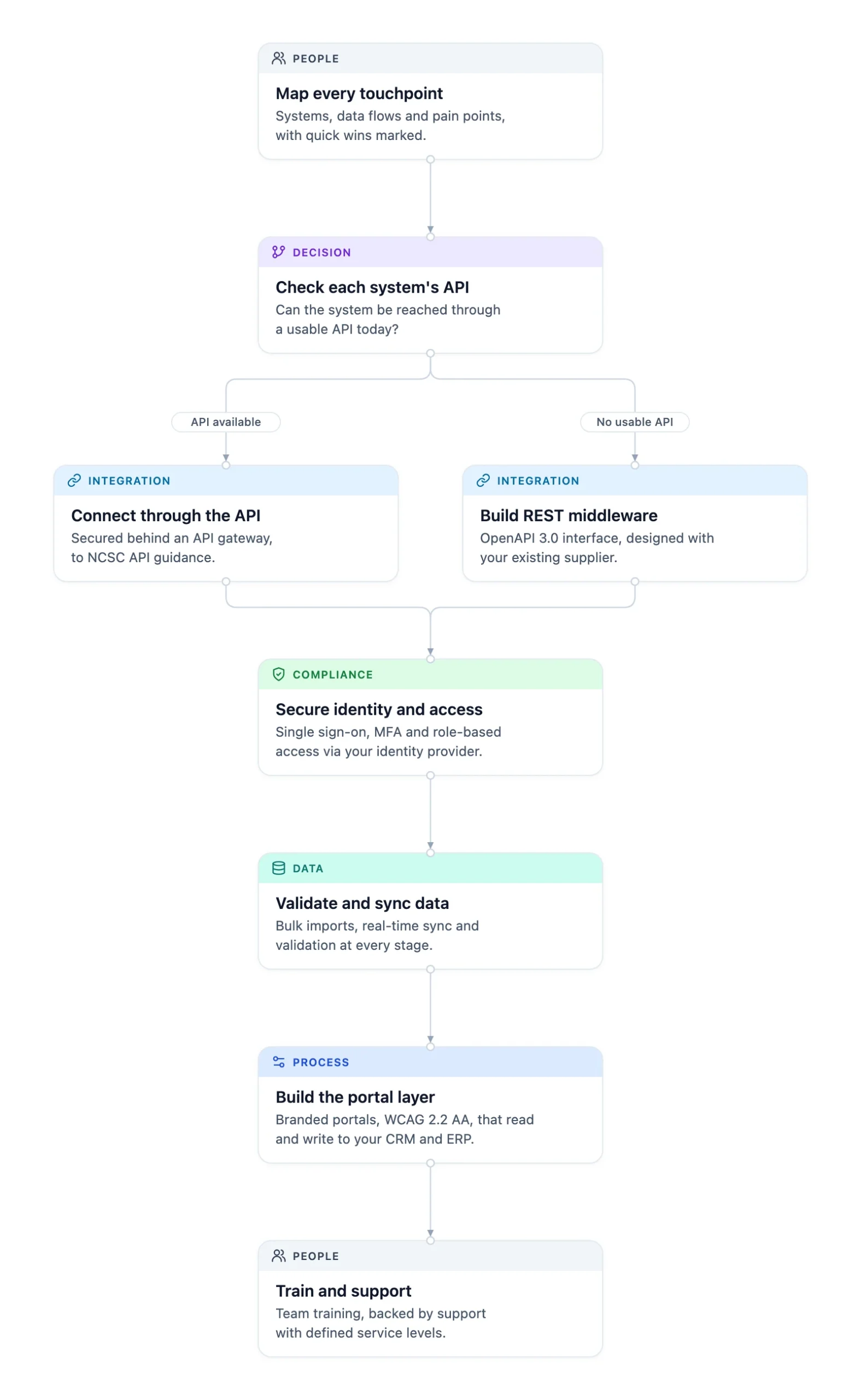
- Map every touchpoint. Review systems, data flows and pain points with IT, compliance and client-facing teams, as the GDS discovery phase describes. Outcome: an integration map with quick wins marked.
- Connect each system. Where a system has an API, connect through it behind an API gateway. Where it has none, build REST middleware documented to OpenAPI 3.0, working with your existing supplier. Outcome: every system reachable through a documented, secured interface.
- Secure identity and access. Set up single sign-on, multi-factor authentication and role-based access through your existing identity provider, such as Microsoft Entra ID. Outcome: each user sees only the data their role allows.
- Validate and sync data. Run bulk imports, real-time sync and data cleansing, with validation at every stage. Outcome: one client record that matches across systems.
- Build the portal layer. Build client and staff portals, accessible to WCAG 2.2 AA, that read and write to the CRM and ERP. Outcome: clients serve themselves and staff stop rekeying.
- Train and support. Train your teams to run the day-to-day, backed by support with defined service levels. Outcome: your team owns the platform.
Every interface is secured as the National Cyber Security Centre’s (NCSC) guidance on HTTP-based APIs and the OWASP Application Security Verification Standard set out.
The design separates concerns. The CRM or ERP stores and processes data, and the new layer handles the joined view and the experience. Thornacre builds no shadow databases, so governance stays simple and there is no extra copy of client data to protect.
Which platforms does a wealth management integration usually connect?
A wealth management integration usually connects the CRM, the finance or ERP platform, document storage and the identity provider, plus any legacy portfolio system through middleware.
| Platform | What the integration does with it |
|---|---|
| Microsoft Dynamics CRM | Reads and writes client records through the Dataverse Web API |
| Microsoft Business Central | Exposes finance and billing data through the Business Central API |
| SharePoint | Stores suitability letters and client documents inside portal workflows |
| HubSpot | Syncs lead capture and marketing forms both ways |
| Microsoft Entra ID | Provides single sign-on, multi-factor authentication and role-based access |
| Legacy portfolio systems | Connect through REST middleware with OpenAPI 3.0 documentation |
The vulnerability flag is the test case. Once the CRM note, the portfolio risk profile and the billing record share one client key, the outcome report can count vulnerable clients the firm already knows about.
How do you choose between replacing and integrating your CRM?
Integrate when your core systems still work and the problem is the gaps between them. Replace when the data model no longer fits the business.
| Criterion | Replace the CRM or portfolio system | Integration layer over existing systems |
|---|---|---|
| Route to first value | Migration comes first | Quick wins from the integration map |
| Migration risk | High; every record moves | Low; data stays where it is |
| Staff retraining | All users | Only portal users |
| Consumer Duty evidence during change | Gap while systems run in parallel | Continuous |
| Fits when | The vendor is ending support | Systems work but do not talk |
Use these rules for your own estate:
- If the system has an API, or can be given one, integrate.
- If the vendor is about to end support, plan a migration instead.
- If users avoid the CRM because its data model is wrong, fix the schema before you connect it.
Fix the client record and the CRM debate often goes away.
When is CRM integration not the right choice for a wealth manager?
CRM integration is the wrong choice when a source system is about to retire, or cannot export structured data at all.
- System at end of life: connecting it adds work you will throw away when it retires.
- No structured data: if a system cannot export data in any structured format, there is nothing to integrate.
- Wrong data model: integration copies a bad model faster; a custom software rebuild may be the better fix.
The trade-off of integration is dependency. Every existing system stays in service, and your incumbent CRM partner must cooperate on new endpoints. That conversation between IT, procurement and the partner is often harder than the build.
The usual objection is “we should just replace the legacy system.” In a regulated firm, replacement means parallel running, a full migration and a gap in outcome evidence while it happens. Waiting adds risk too: every new point-to-point link adds debt, and the next FCA data request will ask the same questions.
What should a wealth manager’s CTO do first?
A CTO should first trace one vulnerability flag from the adviser’s CRM note to the board report, and note every place it stops. That single trace shows where integration is needed.
Take these steps this week:
- Pick one client with a recorded vulnerability, using test or anonymised data.
- Follow the flag from the CRM into the portfolio review, the suitability check and the outcome report.
- Note each break: a manual export, a rekeyed field or a system with no link at all.
- Check each system on the break list for an API, a database view or a structured export.
Frequently Asked Questions
What if our portfolio system is old or has no API?
An old portfolio system with no API can still be integrated through REST middleware documented to OpenAPI 3.0. If a system can export data in any structured format, such as CSV files, database views or scheduled reports, it can be connected. Only a system with no structured export at all is out of reach, and then a migration is the better route.
How does CRM integration help evidence Consumer Duty outcomes?
CRM integration joins the vulnerability flag in the adviser’s CRM note to the portfolio review and the board report. PRIN 2A expects firms to monitor customer outcomes, including for vulnerable customers, and report to the board. With one client record, the outcome report draws on every system, so the board sees vulnerable clients the firm already knows about.
Do we need to replace Dynamics or our finance system first?
A wealth manager does not need to replace Dynamics or its finance system first. An integration layer keeps the existing CRM and ERP as the record and builds on top, so teams keep working in the systems they know. Replacement makes sense only when the vendor is ending support or the data model no longer fits.
Does integration count as outsourcing under SYSC 8?
Integration delivered by a supplier can touch SYSC 8, which sets controls when firms outsource important operational functions. Your compliance team decides whether an arrangement is in scope. Documented interfaces, exit-ready records and defined service level agreements make either answer easier to evidence.
How is client data kept secure across integrations?
Client data is kept secure by running every integration through an API gateway, with encryption in transit and at rest, role-based access and full audit logging. Controls are designed to the NCSC Cloud Security Principles and UK GDPR, with no shadow copies of client data. See Thornacre’s cyber security service.
How do we start?
Start with an integration mapping workshop that traces your client data across CRM, portfolio and finance systems against your Consumer Duty evidence needs. Thornacre’s CRM and ERP integration service runs this as its first phase, and you leave with an integration map and a list of quick wins.
If your client record is split across Dynamics, the portfolio system and finance, book an integration mapping workshop with Thornacre. Email hello@thornacre.com and we will map your systems against your Consumer Duty evidence needs.
This article is general guidance only; consult your legal or compliance teams for your specific requirements.